


In the interview with KC Davis, she mentioned that she doesn’t believe in laziness.
As a therapist I’ve never gotten to the bottom of why someone struggles to do something and found it as just because they were lazy. There is almost always a legitimate barrier like pain, fatigue, executive dysfunction, overwhelm, burn out, lack of support, differing values, mental health issues, etc. Sometimes the issue is that someone is exploiting the labor of another–as in the case of unequal household labor. But even in that case the issue isn’t laziness but entitlement.
Another way to say that (and this is my interpretation, to be clear), is that you are not the failure point.
There’s also the matter of strategic laziness, better understood as “Why should I care about these things?” See quiet quitting, for example. In some situations, for some people, it’s an optimal strategy.
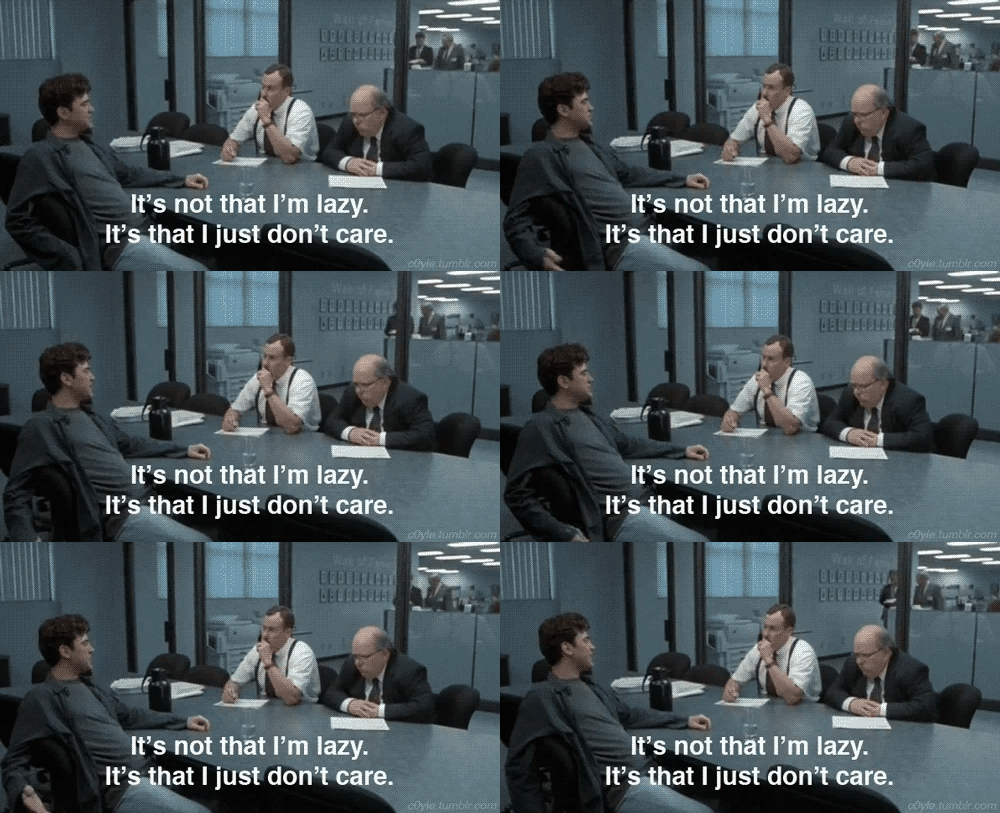
But for the purposes of this post, let’s focus on the kind of laziness (for lack of a better word) that leads to not doing something we want to do.
I agree entirely that there are many barriers along the way that trip us up. Removing these barriers—or at least, making sure that people are aware of them—can be very helpful.
At the same time, this is best understood as a two-part concept. The first part is about the barriers, the problems, the things that cause you to struggle.
All true—and also, there is a second part. The second part is something like “Okay, so what are we going to do about it?”
“Yes, And” (aka Why It’s Important to Try)
As I see it, sometimes people stop at the first part of the concept. They believe themselves to be disenfranchised or simply unable to succeed at their goals, so they stop trying. Perhaps in some ways, giving up can be an act of resistance, but it also doesn’t get you very far.
If you understand that where you are now is not where you want to be, then somehow, something has to change. (One of my favorite sayings is “Nothing changes unless you do.”)
So far in this series I haven’t said much about radical acceptance, a concept that profoundly changed my life once I understood it. In short, radical acceptance is a formula:
Pain + Resistance = Suffering
The key point is that everyone experiences pain at some point, but it’s the resistance of pain that leads to suffering. If we can accept the fact that pain is inevitable, then we suffer less.
This is very helpful!
Radical acceptance does not mean radical resignation. It doesn’t mean we remain entirely passive, especially if there’s something we can do to create a better situation.
We have to be better! (Or at least, we can be better. We don’t have to do anything, but if we can be better, wouldn’t we want to be? We certainly don’t want to be worse, and if things aren’t going great, hopefully they don’t have to be the same forever.)
This, in a nutshell, is my central argument for the whole year of this series. There are things we can do to be better. So why not try?
*No comments on this one, but you can chime in on the original interview with KC if you’d like.
I have a reminder that pops up on my phone that says "Nothing changes if nothing changes". Having that radical acceptance is so important otherwise you're destined to go round in circles 'thinking' you're making changes but not.
Love the distinction between radical acceptance and Resignation
Why not try?
Hope that the future will be better 😀
Thanks again Chris