

Here’s a thing my brain does.
I’ll send a message—an email, a text, a voice mail—and then I’ll wait. While I wait, I decide the delay means something. I was too blunt. Or not warm enough. The other person is annoyed. They’re rethinking the whole relationship. By the time they write back (”sounds good!”) I’ve already attended the funeral for a friendship that was never in any danger.
None of it was real. But it felt real, which is the whole problem.
This feeling is a cognitive distortion: an irrational thought pattern that feels like an accurate read on the situation when it’s nothing of the sort. And when one of these is running quietly in the background, it doesn’t just ruin an afternoon. It locks your anxiety in place and keeps feeding it.
The tricky part is that you almost never notice the distortion itself. You only notice the conclusion—I’m failing, I’m behind, nothing’s going to change. The distortion is the lens that made the conclusion feel obvious. Take the lens off and the conclusion gets a lot harder to defend.
A handful of these show up over and over in people who feel stressed about time (including me, to be clear.) Here are five worth knowing by name.
The five distortions
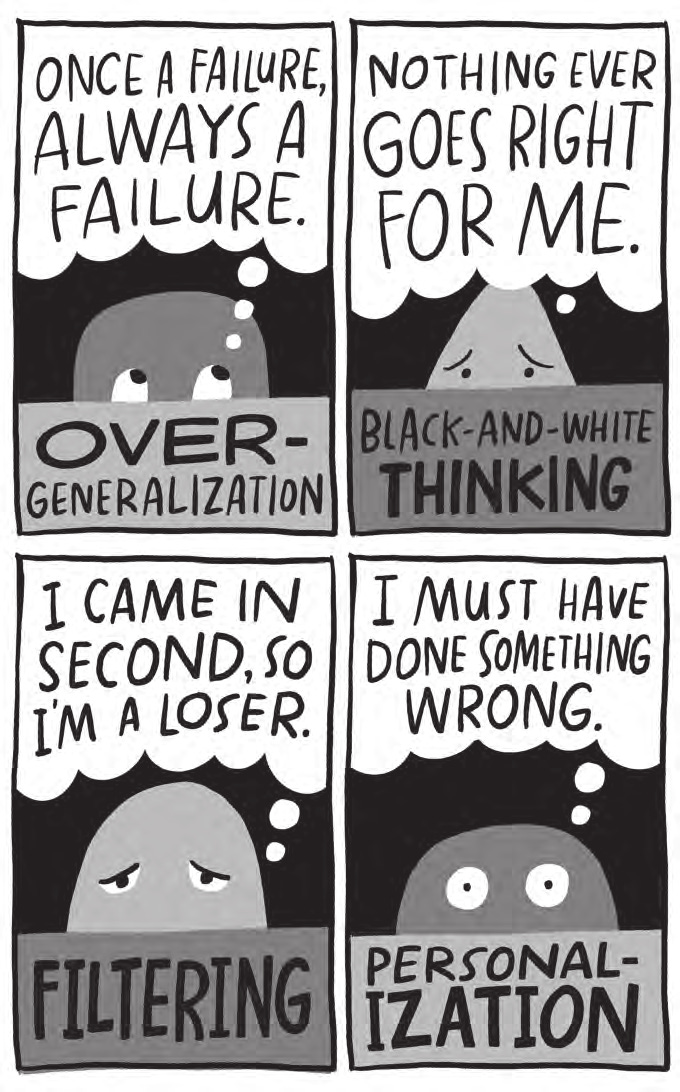
Overgeneralization. One bad moment becomes a permanent forecast. “I missed one deadline, so I’ll always be behind.” A single data point, projected across your entire future.
Black-and-white thinking. The either/or with no middle. “If I can’t do this perfectly, there’s no point starting.” So you don’t start, which guarantees the zero you were afraid of in the first place.
Filtering. Three things went right today and one went wrong, and you already know which one you’ll be replaying at midnight. The good stuff doesn’t even register.
Personalization. Assuming you’re the cause of anything bad within range. “They rescheduled. Must be something I did.” Maybe their kid got sick. You won’t consider it.
Catastrophizing. Expecting the worst, and treating an ordinary stumble like a disaster. This one’s the heavyweight, so it gets its own section.
Catastrophizing comes at you from three directions
Catastrophizing hits the same event from past, present, and future all at once.
It goes after your past (”I made a terrible, unforgivable mistake”), your present (”only an idiot would mess up like that”), and your future (”I’ll never recover from this”)—all aimed at one forgettable experience. Each tense makes the other two worse. The verdict in the present makes your past mistake feel bigger, and the two together make a grim future feel like a foregone conclusion.
An observation: the loop needs all three tenses to hold itself up, but you only have to knock out one to bring it down. Usually the future one works best. “Will I really never recover from this?” is a question that mostly answers itself. (No! You will recover!)
Fun fact, you’ll spot these in a friend before you spot them in yourself
When a friend says “I missed one deadline, I’m going to lose the account, I’ll probably get fired,” you can see the flawed thinking instantly. Naming the distortion gives you that same outside view on your own head.
So here’s the one practice that’s helped me most. Pick a single anxious thought from your day—a real one, ideally about time—and walk through it like this:
Catch it and write it down. Be specific. “I’m going to fail at this whole project because I missed one deadline.” Vague thoughts are slippery; written ones hold still.
Name the lie. Overgeneralization? Catastrophizing? Personalization? If you can’t decide, don’t start spiraling about that too. They overlap, and naming any of them takes the air out of the thought.
Interrogate it. Just like you’d question a suspicious claim from anyone else. “Is this a fact or a guess? What’s my actual evidence? Have I been here before, and what happened last time?”
Write the counter. Skip the pep talk; you won’t believe it anyway. Go for something balanced and true. “I’ve hit deadlines before. Missing one doesn’t sink the project. What’s the next move that makes this one work?”
That’s the whole technique. You won’t catch it the first time, or maybe the tenth. But the distortions have recognizable shapes, and shapes get easier to spot with practice.
The next time your mind tries to send you to a funeral for a friendship that’s doing perfectly fine, you might catch it on the way out the door.
Which of the five cognitive distortions do you identify with the most? What’s been helpful for you?
Sometimes, when getting ahead of myself, I feel like an afterthought🎃
nice red 7.5 inch limp hat
where you at no abbott infiniti g35x gotti?