

I recently accomplished a personal milestone: 2,000 consecutive days of running an average of 5-7 miles a day.
Technically, the achievement is 2,000 days in a row of closing the activity rings on my Apple Watch, but that doesn’t sound as good.
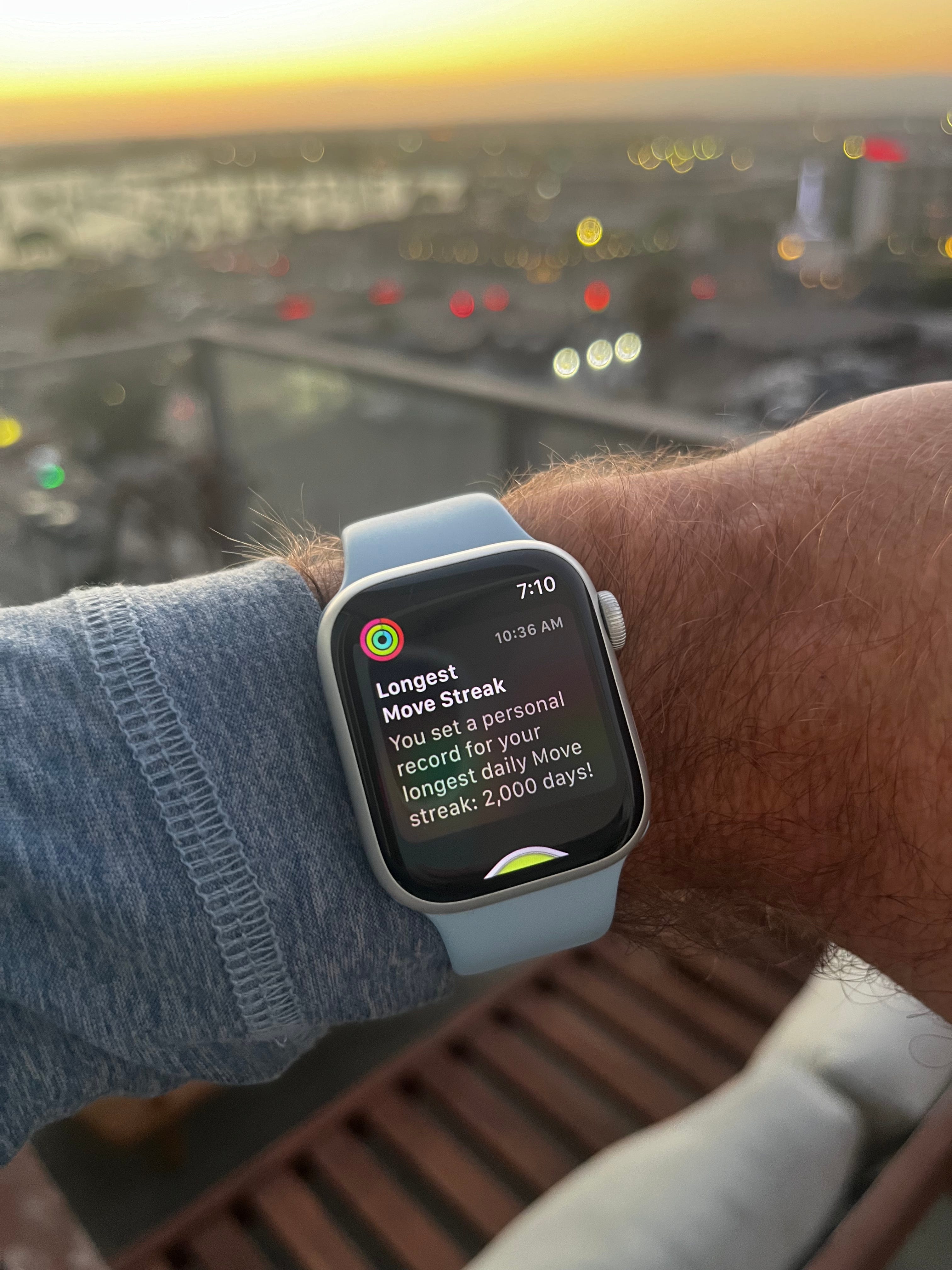
So … that’s great! But it’s not what this post is about, because I know that hearing about someone else’s milestone isn’t always that helpful. Sometimes it can even make you feel bad.
This might just be me, but I sometimes feel envious of other people’s success stories, even though I don’t want to. Or I feel bad that I haven’t been as committed to a habit or goal as they have—which I realize is also problematic.
So here’s something that’s even more helpful than saying “Build a streak.” In fact, it’s a better way to think about most habits and goals.
The Better Rule: Never Skip Two Days in a Row
Instead of building a non-stop, no-exceptions streak, set a rule where you don’t allow yourself to miss twice in a row. That’s it! If you miss one day or one block (whatever it is), no problem—but try not to miss two in a row.
To go back to one of my favorite Gretchen-isms: what we do every day is more important than what we do once in a while.
I’ve thought about that a lot over the past 5.479 years that I’ve had the running streak. For me, the rule of no exceptions has been good for my running streak. Most of the time, it’s not even that hard.1
But I don’t think it would be realistic to apply this rule all the time. For example, I’m not nearly as consistent with other workouts as I am with running. I do strength training at least twice a week, and yoga at least once—but I’m not always rigorous with either. Still, when I miss a session, I try not to miss two in a row.
Similarly, I eat healthy most meals and days, but there are lots of exceptions. I just try to not repeat the exceptions. Pizza one night? Totally fine! I love pizza. But then I try to go back to tofu and grain bowls the next day.
Like I said, the never-miss-two rule is probably even better than building a nonstop, never-miss chain of events. When you break a perfect streak, you feel discouraged and might not want to start over. The other way of thinking of it—just pick it right back up if you stop—is potentially much more useful.
The grammar isn’t perfect, but you could also think of it as “Don’t stay stopped.”
Shake it off and get back up! Don’t miss two in a row.

Have you ever had a long streak? What was it, and what did you learn from it?
P.S. I didn’t end the streak with 2,000 days last week. Right now I’m on day 2,009 and there’s no real goal attached to it—I just don’t see any reason to stop, so I’ll keep it going for the foreseeable future.
P.P.S. Rachelle Fordyce, an Instagram friend of mine, is also approaching day 2,000! Aside from fellow author David Sedaris, who seems to be just as compulsive as Rachelle and me, she’s the only other person I know who’s been doing this as long. (But if you know someone else, feel free to mention them in the comments.)
Difficult days over the past few years have included: the day after running a marathon, the days after getting vaccinated and boosted, travel days when I leave early in the morning and don’t get out of an airport until late at night, and twice when I was sick with COVID.
There's a clear caveat missing here and that is if you are really sick, rest. Like, truly rest, sans shame — streak be damned, missing more than two days in a row be damned. I have had colds that kept recurring for 6+ months and I think a lot of that was not letting myself truly rest (also: I have discovered that I have a version of asthma that really only is an issue when I am sick). Since then, I have found that actually letting myself do nothing but drift in and out of sleep all day and eat when I'm hungry has allowed me to get over illness in 2-3 days; covid maybe more like four. And of course, there are people for whom covid has been a total disaster, even when they did fully take care of themselves.
You have a footnote, but it reads like you "pushed through" even though it was "difficult" and maintained your streak of running every day even when you were legitimately ill. I'm not sure that's the message you want to send, if the theme of your substack is ultimately about taking care of oneself so that one can do the important work.
Yes awesome, but... from my personal experience I would recommend you slow down. Why? What you overdo today will come up later in your life and haunt you. I climbed the Kilimandjaro with a 75 year old man who barely was able to climb. His knees were shot. He was a downhill champion skier during his University years. Every day on the Kili was as painful as doing a marathon for him. Now I am 75 years old myself. I jogged a lot, played baseball excessively when I was a teen and played tennis most of my life too. Today, I would like to continue to play tennis, but it is very painful and I have to have 3 days of rest between matches. The knees and my right shoulder just can't take it anymore. I wonder how it would be like today if I had not gone overboard when I was younger. Food for thought and good discussions.